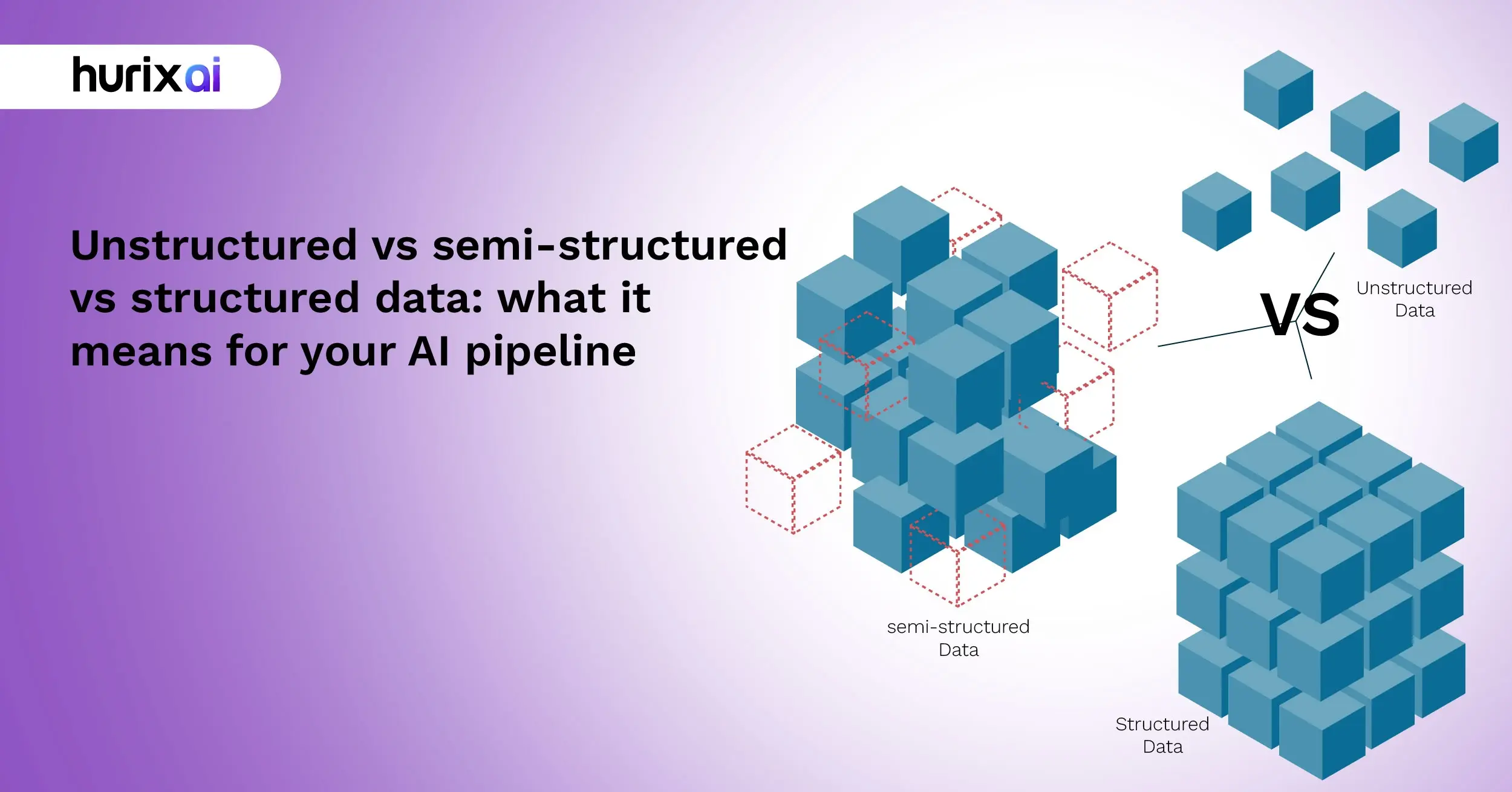
Every AI project begins long before model training. It begins with data. Mountains of it. Some of it arrives neat and tidy. Some of it arrives wild and unpredictable. And some sits in a confusing middle zone that looks organized at first glance, only for you to realize later that the labels and formatting have minds of their own.
This is where understanding structured vs unstructured data becomes extremely important. Models behave differently depending on what kind of data they are fed. And your pipeline changes dramatically depending on the complexity of that data. If the data is structured, life feels calm. If the data is unstructured, chaos enters the chat. And if the data is semi structured, your team might argue about whether it is tidy or messy for the rest of the project.
Your AI pipeline depends on how you store, format, annotate, clean, and process each type of data. This article explores what these categories mean, how they influence model accuracy, and why your AI project can succeed or fail based on how you treat structured vs unstructured data. Expect practical explanations, simple language, and a sprinkle of humor to keep the reading experience as smooth as possible.
Table of Contents:
- Understanding Structured vs Unstructured Data in AI Workflows
- Why Structured vs Unstructured Data Matters for AI Pipelines
- Real Business Impact of Structured vs Unstructured Data in AI
- How Structured vs Unstructured Data Influences Data Labeling
- How Structured vs Unstructured Data Influences AI Pipeline Performance
- Best Practices for Managing Structured vs Unstructured Data in AI Pipelines
- Conclusion
- FAQS
1. Understanding Structured vs Unstructured Data in AI Workflows
Your AI pipeline relies on data that can be read, cleaned, and labeled without too much pain. But not all data behaves the same way. Some data follows rules. Some does not. And some pretends to follow rules until you try to parse it at scale and discover it was lying the entire time.
So let us explore the three main categories and how structured vs unstructured data shapes your AI development process.
1.1 What Is Structured Data
Structured data is the most organized form. This data lives in tables, spreadsheets, relational databases, and consistent fields. Every value has a clear meaning. Every column behaves predictably.
Structured data includes
• Sales records
• CRM entries
• Financial transactions
• Product catalogs
• Time stamped values
• Sensor logs with predefined fields
Since structured data follows a pattern, it integrates smoothly into AI pipelines.
Why structured data is friendly for AI
• Easy to store
• Easy to query
• Easy to clean
• Easy to analyze
Models that rely on structured data need less preprocessing and behave more predictably.
1.2 What Is Unstructured Data
Unstructured data is the rebel of the data world. It ignores tables. It ignores columns. It arrives however it wants. You cannot place it neatly into rows without transforming it.
Examples include
• Images
• Audio
• Video
• Emails
• Chat transcripts
• Social media posts
• Natural language documents
• Medical scans
Unstructured data forms the majority of global information. It is rich in value but painfully messy.
Why unstructured data complicates AI pipelines
• No predefined format
• Requires custom annotation
• Difficult to parse
• Must be transformed before modeling
This makes structured vs unstructured data one of the biggest concerns in machine learning.
1.3 What Is Semi Structured Data
Semi structured data looks somewhat organized but does not fit into a strict table. It contains tags, metadata, or partial structure.
Common examples include
• JSON files
• XML files
• HTML
• Logs with irregular fields
• Emails with metadata but messy body text
Semi structured data occupies the grey area between structured vs unstructured data. It offers structure but without guarantees.
Why semi structured data matters for AI
• It bridges both ends
• It can be cleaned to become structured
• It may require annotation like unstructured data
Understanding how it behaves helps you design better preprocessing steps.
2. Why Structured vs Unstructured Data Matters for AI Pipelines
Your AI pipeline depends on how you collect, clean, and annotate data. When you compare structured vs unstructured data, the differences shape every stage of your workflow.
2.1 Data Ingestion Requirements Change Completely
Structured data can flow directly into databases. Unstructured data demands specialized storage systems that can handle large files and flexible formats. Semi structured data needs parsers.
Ingestion requirements vary
• Structured data uses relational stores
• Semi structured data uses document stores
• Unstructured data uses storage systems for binary or complex formats
The type of data influences your entire architecture.
2.2 Annotation Workflows Depend on Data Type
Data annotation becomes essential when dealing with unstructured and semi structured content. For structured data labeling is often built in. For unstructured data, labeling is an entire project.
Annotation intensity across types
• Structured data needs minimal annotation
• Semi structured data needs targeted annotation
• Unstructured data needs intensive labeling
This is one of the biggest differences in structured vs unstructured data.
2.3 Model Selection Depends on Data Structure
Different models work best for different types of data.
• Structured data supports tree models, regression, clustering, and tabular deep learning
• Unstructured data supports computer vision, natural language processing, audio models, multimodal models
• Semi structured data can support both types
Your choice of model changes the entire training pipeline.
2.4 Preprocessing Requirements Vary Dramatically
Structured data requires cleaning, normalization, and transformation. Unstructured data requires metadata extraction, segmentation, and conversion into analyzable formats.
Semi structured data requires parsing, mapping, and restructuring.
2.5 Storage and Infrastructure Decisions Depend on Data Type
The systems that store structured vs unstructured data differ widely.
• Structured data fits in conventional SQL
• Semi structured data fits in document databases
• Unstructured data needs distributed file systems and object storage
Failing to match the data type with the right infrastructure slows the entire AI pipeline.
3. Real Business Impact of Structured vs Unstructured Data in AI
Understanding these data types is not a theoretical exercise. It influences speed, accuracy, cost, and the final performance of your AI model.
3.1 Structured Data Accelerates AI Development
Because structured data is easy to manipulate, models reach usable accuracy faster. You spend less time annotating, cleaning, and decoding formats.
This makes structured data ideal for
• Finance
• Retail forecasting
• Inventory management
• Healthcare administration
• Industrial monitoring
3.2 Unstructured Data Unlocks Deeper AI Power
Unstructured data contains far richer information than structured data. A single image can contain tens of thousands of meaningful features. A video can reveal behavioral patterns. Audio can reveal sentiment and tone.
This is why unstructured data powers
• Computer vision
• Natural language processing
• Autonomous driving
• Speech recognition
• Document intelligence
The tradeoff is that it requires more labeling and more preprocessing.
3.3 Semi Structured Data Offers a Balance
Semi structured data gives you context without rigid format. Tags and metadata help models understand content more quickly.
This middle ground helps with
• Email classification
• Log analytics
• Web data extraction
• Customer support analytics
It mixes the benefits of structured vs unstructured data and creates flexibility.
4. How Structured vs Unstructured Data Influences Data Labeling
Labeling is the heart of supervised learning. Without high quality labeling, no model performs well. The type of data you have determines how difficult annotation becomes.
4.1 Labeling Structured Data
Structured data usually comes with built in labels. The challenge is verifying accuracy, not creating labels.
Labeling tasks include
• Correcting missing values
• Standardizing field names
• Validating entries
Annotation here is light.
4.2 Labeling Unstructured Data
Unstructured data requires the most effort.
Labeling tasks include
• Bounding boxes for images
• Semantic segmentation
• Named entity extraction
• Sentiment tagging
• Audio transcription
• Video frame labeling
Unstructured data drives many of the core AI innovations today but demands serious annotation investment.
4.3 Labeling Semi Structured Data
Semi structured data requires mixed annotation.
Tasks include
• Labeling inside the structured parts
• Parsing metadata
• Annotating unstructured segments
This category often confuses teams until they understand structured vs unstructured data thoroughly.
5. How Structured vs Unstructured Data Influences AI Pipeline Performance
Your AI pipeline is only as efficient as your data structure. Poor handling slows everything down.
5.1 Pipeline Complexity Changes Based on Data Type
Structured data pipelines are simpler. Unstructured data pipelines require
• Data extraction
• Feature engineering
• Annotation systems
• Storage layers
Semi structured data sits between these extremes.
5.2 Training Times Depend on Data Format
Unstructured data takes longer to preprocess and train. Structured data trains far faster because the format is predictable.
5.3 Model Accuracy Depends on Label Quality
In the battle of structured vs unstructured data, unstructured datasets require far more labeling to reach high accuracy. Structured data models reach accuracy sooner because the content is already clean.
6. Best Practices for Managing Structured vs Unstructured Data in AI Pipelines
Here are practical steps to improve data quality and model accuracy.
6.1 Identify Your Data Types Early
Knowing what you are dealing with helps you design the right pipeline.
6.2 Build Separate Workflows for Each Data Type
Different formats need different preprocessing strategies.
6.3 Use Strong Annotation Guidelines for Unstructured Data
Consistency improves model accuracy dramatically.
6.4 Store Data in Systems Designed for Its Format
This prevents long term data bottlenecks.
6.5 Validate Data Often
Regular checks prevent errors from multiplying.
6.6 Never Treat All Data Types the Same
The biggest mistake is treating structured vs unstructured data as identical. They are not.
Conclusion
Understanding structured vs unstructured data is essential for designing efficient AI pipelines. Structured data accelerates development, while unstructured data unlocks deeper, richer insights. Semi structured data offers a flexible middle path. When teams understand how each type behaves, they can build stronger workflows, improve annotation quality, and increase model accuracy. If you want help managing structured vs unstructured data for your AI projects, feel free to reach out through the contact us page to build a smarter data pipeline.
Frequently Asked Questions (FAQs)
Structured data is organized in tables, while unstructured data includes images, audio, text, and videos that do not follow a clear format.
It has no built in structure, so humans must annotate objects, text, and signals manually.
It includes tags and metadata, offering partial structure without fixed fields.
It shapes storage, preprocessing, annotation, modeling, and accuracy.
All three have value, but structured data trains faster while unstructured data creates more powerful models.
Yes. Many advanced systems combine both to create stronger AI performance.

Vice President – Content Transformation at HurixDigital, based in Chennai. With nearly 20 years in digital content, he leads large-scale transformation and accessibility initiatives. A frequent presenter (e.g., London Book Fair 2025), Gokulnath drives AI-powered publishing solutions and inclusive content strategies for global clients