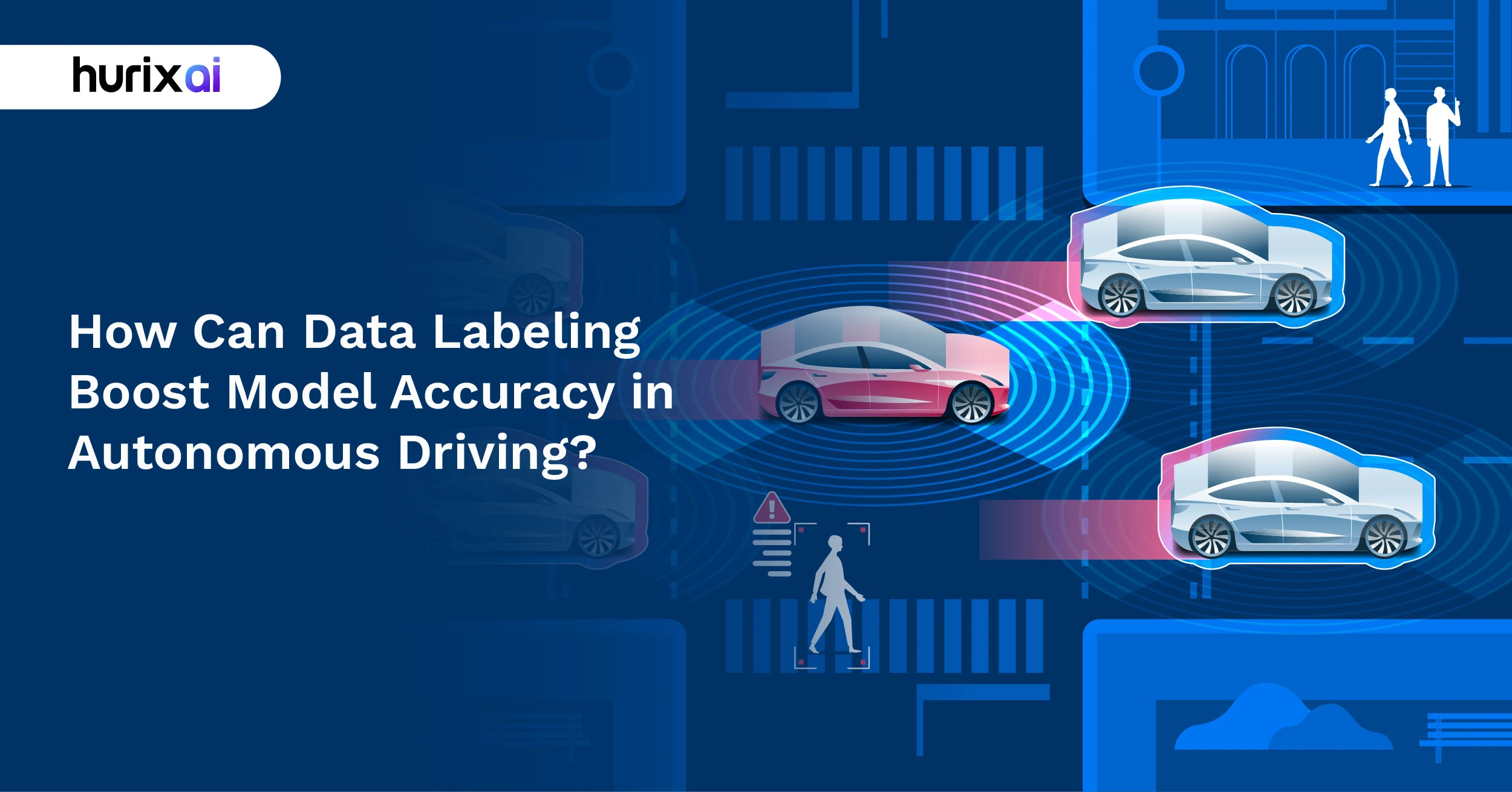
Autonomous driving may look futuristic, but behind every smooth lane change and confident turn lies a large mountain of training data. Cars do not learn how to drive magically. They learn from labeled examples. This is where autonomous vehicle data labeling becomes the real engine behind model accuracy. Without clear and consistent labels, even the most advanced driving model cannot understand the world. The car sees pixels and objects, but it does not know what anything means.
Labeling gives the model its understanding. When you label pedestrians, lanes, traffic signals, distance markers, curbs, road edges and moving objects, the model begins to interpret the environment. It starts recognizing patterns. It understands what to expect. It gains context and clarity. That is the foundation of safe autonomous driving.
This article explores how autonomous vehicle data labeling boosts accuracy, improves perception, reduces risk, and speeds up the entire development cycle. You will find examples, best practices, and a friendly conversational tone that makes the technical world feel much easier to read. No stiff robotic phrasing. No complicated jargon that slows you down. Just clear and manageable explanations of how labeling powers autonomous driving.
Table of Contents:
- Why Autonomous Vehicles Depend on High Quality Data Labeling
- Key Elements of Autonomous Vehicle Data Labeling
- How Autonomous Vehicle Data Labeling Boosts Model Accuracy
- Best Practices in Autonomous Vehicle Data Labeling
- The Role of Consistency in Model Accuracy
- Future Trends in Autonomous Vehicle Data Labeling
- Conclusion
- FAQS
1. Why Autonomous Vehicles Depend on High Quality Data Labeling
Autonomous vehicles rely heavily on data. Cameras, radar, lidar, and sensors produce endless streams of raw inputs. But raw inputs alone are not enough. They need structure. They need labels. They need meaning.
Here is why labeling matters so much.
1.1 The Model Learns from Labeled Examples
AI does not understand the world naturally. It learns what a pedestrian looks like based on examples. It learns what a stop sign means because training data tells it so. Without high quality labels, the model cannot map patterns correctly.
• Which objects are safe
• Which objects require braking
• Which objects signal rules
• Which objects demand priority
Good learning begins with good labeling.
1.2 Autonomous Driving Involves Enormous Data Volumes
Autonomous vehicles collect large volumes of visual and sensory information every minute. Labeling this data is the only way to make it usable for training. And because models require millions of examples, consistency becomes essential.
1.3 Small Labeling Errors Create Large Driving Risks
A tiny mislabel may look harmless, but in autonomous driving, the margin for error is very small. A mislabeled lane or a mislabeled pedestrian could create major risks. Consistent labeling reduces these dangers significantly.
1.4 Labeling Defines the Entire Perception Flow
Perception systems depend entirely on labeled data. The model cannot detect or classify correctly without clear examples. Labeling helps the car understand its surroundings and take safe actions.
2. Key Elements of Autonomous Vehicle Data Labeling
Labeling for autonomous vehicles goes far beyond simple object tagging. It is one of the most complex labeling domains. It involves multiple data types, sensor formats, and layers of detail.
2.1 Image Labeling for Camera Inputs
Cameras capture the world visually. Autonomous vehicle data labeling adds meaning to images by marking objects like:
• Cars
• Trucks
• Pedestrians
• Bicycles
• Lane lines
• Traffic lights
• Signs
• Road edges
• Construction zones
Accurate image labeling helps the model interpret visual scenes correctly.
2.2 Sequence Labeling for Video Frames
Autonomous driving involves movement. Objects appear, disappear, and move across frames. Labeling video sequences helps the model understand motion patterns and predict behavior.
• How pedestrians move across crosswalks
• How other vehicles merge
• How traffic flow changes
Sequence labeling improves real time decision making.
2.3 Three Dimensional Labeling for Lidar Data
Lidar creates three dimensional point clouds. These clouds represent distance, shape, and structure. Labeling point clouds is far more complex than two dimensional data. Annotators must mark objects from every angle.
• Vehicle outlines
• Pedestrian shapes
• Obstacles
• Poles and road furniture
• Distance mapping
This is one of the most important areas of autonomous vehicle data labeling.
2.4 Multi Sensor Fusion Labeling
Vehicles combine multiple sensors to improve perception. Cameras, lidar, radar, and ultrasonic sensors all provide different pieces of the puzzle. Labeling across these sources helps the model fuse information correctly.
• More accurate distance measurement
• Better detection of small objects
• Stronger navigation skills
Reliable fusion depends on strong labeling.
3. How Autonomous Vehicle Data Labeling Boosts Model Accuracy
Model accuracy improves when the training data is clean, consistent, and comprehensive. Let us explore the major ways autonomous vehicle data labeling enhances performance.
3.1 More Accurate Object Detection
Object detection is one of the core tasks in autonomous driving. The model must identify cars, pedestrians, bicycles, animals and other objects clearly. Labeling improves object detection by showing the model thousands of examples for each object category.
• Prevents collisions
• Improves lane changes
• Enhances reaction time
High accuracy leads to safer driving.
3.2 Better Lane Positioning
Lane detection depends entirely on labeled examples. If lane lines are labeled well, the model learns how to stay centered, when to change lanes, and how to navigate unusual lane patterns.
• Highway driving
• City navigation
• Traffic merging
Correct lane positioning is one of the biggest contributors to overall driving accuracy.
3.3 Improved Prediction of Moving Objects
A major part of autonomous driving involves prediction. Cars need to know where a pedestrian will be one second from now. They need to know whether a cyclist plans to turn. They need to estimate how fast a car is accelerating.
• Object movement
• Object speed
• Object direction
Sequence labeling plays a huge role in improving predictions.
3.4 Stronger Road Surface Understanding
Roads include many details: potholes, markings, surfaces, texture differences, and painted guides. Labeling these features helps the model identify safe paths.
• Avoid unsafe areas
• Understand upcoming terrain
• Improve suspension response
This makes driving smoother and safer.
3.5 Clearer Traffic Light Interpretation
Traffic lights come in different shapes, sizes, colors, and positions. Proper labeling trains the model to recognize the state of each light clearly.
• Stop at the right time
• Avoid traffic violations
• Improve intersection safety
Accuracy here is essential for public trust.
3.6 Enhanced Scene Understanding
Autonomous driving involves more than identifying objects. The car must understand the entire scene. Scene labeling helps models:
• Identify road type
• Detect school zones
• Interpret construction sites
• Understand unusual scenarios
Scene understanding makes autonomous vehicles more reliable.
4. Best Practices in Autonomous Vehicle Data Labeling
Labeling for autonomous vehicles requires careful planning. The complexity of the environment demands a structured approach.
4.1 Create Detailed Annotation Guidelines
Annotators need clear rules. Guidelines cover labeling boundaries, object definitions, and examples for edge cases.
• Examples of difficult scenarios
• Clear label definitions
• Instructions for unusual scenes
Strong guidelines reduce confusion.
4.2 Use Multi Level Review Processes
Reviewers help ensure consistency. Multi level review processes catch mistakes and refine labeling logic.
• Annotator
• Reviewer
• Senior reviewer
Layers of verification create a more reliable dataset.
4.3 Calibrate Annotators Frequently
Calibration aligns annotators by letting them label the same sample set and comparing interpretations.
• Reduce variance
• Improve agreement
• Identify training gaps
Frequent calibration supports a unified approach.
4.4 Combine Automation with Human Intelligence
Automation can pre label simple objects. Humans handle complex scenes. This hybrid approach speeds up labeling without lowering quality.
4.5 Handle Edge Cases Separately
Autonomous driving has many rare scenarios. These require separate review and expert input.
• Unusual weather
• Strange road structures
• Unexpected obstacles
Handling edge cases separately protects the dataset from inconsistent labeling.
4.6 Use Secure Labeling Environments
Self driving datasets often contain sensitive information. Secure environments protect this data.
5. The Role of Consistency in Model Accuracy
Consistency is essential for model accuracy. In autonomous driving, data variety is huge. Roads change. Lighting changes. Traffic changes. Scenes change constantly. Consistent labeling brings order to this variety.
5.1 Consistent Definitions Reduce Confusion
If every annotator has a different definition of what counts as a pedestrian, the model becomes confused. Clear and consistent definitions prevent misclassification.
5.2 Consistent Boundaries Improve Detection
Accurate bounding and segmentation improve object detection performance. Consistent boundaries help the model understand object shapes and sizes.
5.3 Consistent Scene Labeling Strengthens Navigation
Scene level labels help with path planning. Consistency ensures that similar scenes produce similar actions.
6. Future Trends in Autonomous Vehicle Data Labeling
Autonomous vehicle data labeling is evolving rapidly. New approaches help improve accuracy and reduce the burden on annotators.
6.1 Self Supervised Learning
Models are beginning to learn from unlabeled data. This reduces the labeling load but still relies on high quality labeled samples for fine tuning.
6.2 Synthetic Data Generation
Synthetic scenes created through simulation offer additional training material. These still require labeling but at a faster rate.
6.3 More Advanced Annotation Tools
Tools now support smart suggestions, enhanced tracking, and automated scene recognition.
Conclusion
Accurate autonomous vehicle data labeling is the backbone of reliable self driving systems. Every clear label improves the model’s ability to detect objects, understand scenes, predict movement, and make safe decisions. By using strong guidelines, multi level reviews, calibration sessions, and hybrid workflows, businesses can boost model performance significantly. If you want help improving your autonomous vehicle data labeling workflows, feel free to reach out through the contact us page to build a strong and scalable labeling strategy.
Frequently Asked Questions (FAQs)
It teaches the model how to understand roads, objects, and safety rules accurately.
It involves marking objects inside three dimensional point cloud data from lidar.
Yes. Better labeling improves prediction of pedestrian movement, vehicle speed, and behavior.
Yes. Tools with smart features reduce repetitive work and improve accuracy.
Through strong guidelines, calibration sessions, and multi level reviewing.
Absolutely. Accurate labeling improves detection, navigation, and reaction time.

Vice President – Content Transformation at HurixDigital, based in Chennai. With nearly 20 years in digital content, he leads large-scale transformation and accessibility initiatives. A frequent presenter (e.g., London Book Fair 2025), Gokulnath drives AI-powered publishing solutions and inclusive content strategies for global clients